Imagine standing on your back porch on a humid July evening, only to be driven indoors by a persistent swarm of biting insects. If you have ever looked at a cedar box and wondered do bat houses work as a natural defense against these pests, you are part of a growing movement of homeowners seeking chemical-free solutions. Many people believe that simply hanging a wooden box will solve their bug problems overnight, but the reality is more nuanced than the marketing suggests.
Do bat houses work for mosquito control?
Yes, bat houses work as part of an integrated pest management strategy, but they are not a standalone cure. While bats can eat 1,000+ insects hourly, mosquitoes usually comprise only 1% to 30% of their diet. Success depends on using multi-chamber designs and precise 15-20 foot mounting heights to ensure occupancy.
The Reality of Bat Diets and Mosquito Consumption
To understand the effectiveness of bat houses, we have to look at what these animals actually eat in the wild. A common statistic floating around the internet claims that a single bat can eat 1,200 mosquitoes in an hour. This number comes from laboratory studies where bats were presented with nothing but mosquitoes. In a controlled environment, these insect-eating bats are incredibly efficient. However, the natural world is not a laboratory.
Research from the University of Wisconsin-Madison and other ecological institutions shows that bats are opportunistic hunters. Because they need to maximize their energy gain, they often target larger “meaty” insects like moths and beetles. A large moth provides the same caloric value as dozens of tiny mosquitoes. Because of this, bat houses for mosquito control should be viewed as a way to reduce the overall insect load rather than a targeted strike against one species.
Recent guano analysis suggests that mosquitoes make up a variable portion of the diet. For some species, like the Little Brown Bat (Myotis lucifugus), mosquitoes are a frequent snack. For others, they are merely an appetizer. If your goal is mosquito control using bats, you are likely to see a reduction in the “nuisance cloud” around your home, but you won’t achieve 100% eradication through bats alone.
Do Bat Houses Really Help With Mosquito Control?
The question of whether these structures provide tangible benefits of bat houses for pest control depends heavily on occupancy. A box that stays empty for five years provides zero benefit. Statistics from conservation groups indicate that occupancy rates for single-chamber, poorly placed houses are below 20%. Conversely, BCI certified multi-chamber houses that follow strict design guidelines see success rates over 80%.
Homeowners on platforms like Reddit often share polarized experiences. One user might report a massive drop in pest activity after a colony of 50 bats moves in. Another might complain that their expensive cedar box has remained a “ghost town” for three seasons. This discrepancy usually traces back to the quality of the bat habitat provided.
Bats are social animals that require specific thermal conditions. They aren’t looking for a “house” so much as they are looking for a nursery. A successful box helps maintain a stable temperature for flightless pups. When you provide the right environment, you attract insectivorous bats that will return to your yard every single night. This consistent predation is what leads to long-term outdoor pest management success.
Proper Placement of Bat Houses for Maximum Efficiency
If you want to attract bats to your yard, you cannot simply nail a box to a tree and hope for the best. In fact, mounting a house on a tree is one of the most common reasons for failure. Trees provide too much shade, which prevents the house from reaching the high temperatures bats need. Furthermore, trees give easy access to predators like owls, snakes, and squirrels.
| Requirement | Optimal Specification |
| Mounting Height | 15 to 20 feet above the ground |
| Sun Exposure | 6 to 8 hours of direct morning sun |
| Mounting Surface | Buildings or dedicated poles (Avoid trees) |
| Distance to Water | Within 1/4 mile of a fresh water source |
| Clearance | 20 feet of clear flight path in front of entry |
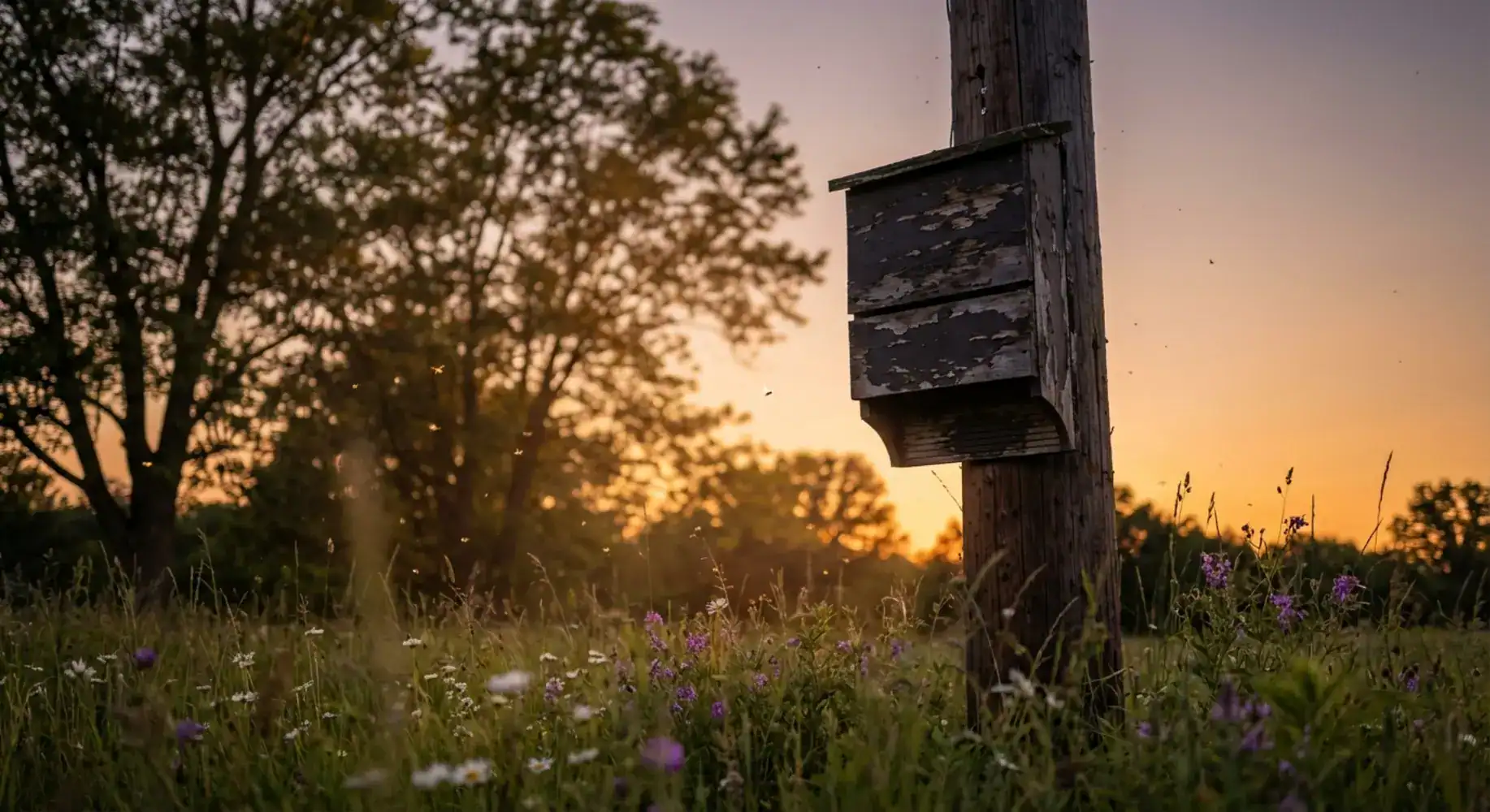
For bat house placement for maximum efficiency, aim for a south or southeast-facing wall. The morning sun is critical for warming the colony after a long night of hunting. In cooler climates, you may even need to paint the box a dark color to absorb more heat. In the South, a lighter tan or gray is better to prevent overheating. Specifically, the internal temperature should stay between 80°F and 100°F for optimal pup growth.
The Design Secret: How Many Bats Fit in a Bat House?
Many people are surprised by how many bats fit in a bat house. A standard three-chamber nursery box can easily hold 100 to 300 bats. These animals are incredibly small and prefer to huddle together for warmth. If you are serious about natural mosquito predators, a larger colony is always better than a few lone males.
When you are looking to build or buy an effective bat house, the internal dimensions are non-negotiable. The roosting chambers must be exactly 3/4 inch to 1 inch wide. If the gaps are wider, predators can reach inside. If they are narrower, the bats won’t fit. Additionally, the interior wood must be roughened or grooved. Bats cannot hang on smooth surfaces. Many “cheap” commercial boxes fail because the wood is too slick, leaving the bats unable to climb into the safety of the chambers.
Bat House Maintenance Tips and Upkeep
Once you have residents, you need to follow basic bat house maintenance tips. These structures are not “set it and forget it.” Because of the high nitrogen content in guano, the area underneath the house will require regular attention. Many gardeners view this as a benefit rather than a chore.
- Collect the guano to use as a powerful, high-phosphorus fertilizer for your flower beds.
- Inspect the house every winter for wasp nests or bird intrusions.
- Check the caulking and paint every two years to prevent leaks or wood rot.
- Ensure that no branches have grown into the flight path of the bats.
Effective maintenance and upkeep of bat houses ensures the colony stays healthy and returns year after year. If the box begins to rot or develop drafty cracks, the bats will find a more stable roost elsewhere, often in a nearby attic or barn.
Misconceptions About Bat House Effectiveness
There are several misconceptions about bat house effectiveness that lead to frustration. The biggest myth is that bats will “attract” more bugs to your yard. In reality, bats follow the food. They aren’t bringing the mosquitoes with them; they are coming because the mosquitoes are already there.
Another common fear involves concerns over bat health and habitat, specifically the risk of rabies. While any mammal can carry rabies, less than 1% of wild bats actually have the virus. Because bats avoid human contact, the risk is extremely low as long as you do not handle them. Having a bat house 20 feet up a wall is significantly safer than having bats roosting inside your home’s attic.
Finally, some people worry that bats will get stuck in their hair or attack them. This is biologically impossible. Bats use echolocation to navigate, which is precise enough to detect a single strand of human hair. They have no interest in humans and are only focused on the pest control solutions they provide by clearing the air of moths, beetles, and gnats.
Alternatives and Integrated Eco-Friendly Pest Control
While we have established that are bat houses effective against mosquitoes, they work best when paired with other methods. If you rely solely on bats, you might be disappointed during a particularly wet spring when mosquito breeding is at its peak.
- Mosquito Dunks: Use these Bti-based tablets in standing water to kill larvae before they hatch.
- Natural Repellent Plants: Surround your patio with lavender, lemongrass, and lemon balm.
- Proper Drainage: Clear your gutters and tip over any containers that hold water.
- Air Flow: Using a simple oscillating fan on your deck can be more effective than any repellent because mosquitoes are weak fliers.
This integrated pest management approach creates a multi-layered defense. The bats handle the high-flying insects, while the dunks and drainage prevent the next generation of biters from maturing. This is the hallmark of truly eco-friendly pest control.
The Impact of Bats on the Ecosystem
Beyond your backyard, bat conservation has massive implications for our food supply. Research shows that bats save the United States agricultural industry roughly $3.7 billion every year by eating crop-destroying pests like the corn earworm moth. In places like Lockhart, Texas, farmers use hundreds of bat boxes to protect pecan orchards without using a single drop of synthetic insecticide.
When you install a bat house, you are supporting urban wildlife that is currently under threat. White-nose syndrome has decimated bat populations across North America, killing millions of individuals since 2006. By providing a safe, warm nursery, you are helping these species recover. The bat house benefits extend far beyond your personal comfort; you are participating in a global conservation effort.
Common Questions About Bat Houses for Mosquito Control: Fact or Fiction?
How many mosquitoes does a bat eat in one night?
In a natural setting, a single bat likely eats several hundred to a few thousand insects. While the “1,200 per hour” stat is lab-based, a colony of 100 bats can still consume hundreds of thousands of pests every single night.
Will a bat house attract bats into my attic?
No, a bat house actually prevents bats from entering your attic. Bats only enter homes when they cannot find a suitable natural roost. Providing a high-quality box gives them a preferred alternative that is warmer and safer than your eaves.
What is the best wood for a bat house?
Cedar is the top choice because it is naturally rot-resistant and provides excellent insulation. You can also use exterior-grade plywood, but it must be treated with water-based stain or outdoor paint to prevent warping from the sun.
How long does it take for bats to find a bat house?
It generally takes between 1 and 5 years for a new house to be discovered. However, if you are performing a legal “bat exclusion” to move them out of your house, they may occupy the new box within 24 to 48 hours.
Are bat houses noisy at night?
Bats are relatively quiet neighbors. You might hear some faint clicking or social “chattered” noises as they return to the roost at dawn, but they are not nearly as loud as birds or crickets.
Do bat houses carry diseases?
The primary concern is histoplasmosis, a fungus that can grow in accumulated guano. To mitigate this risk, never mount a bat house directly over a door or walkway, and wear a mask if you are cleaning out large amounts of dry guano.
References & Expert Sources
- Bat Conservation International (BCI)
- Merlin Tuttle’s Bat Conservation
- U.S. Geological Survey: Bat Research
- National Wildlife Federation: Attracting Bats
- USDA Forest Service: Bats and Pest Control
- University of Wisconsin-Madison: Bat Diet Studies
- BatBnB: Design and Placement Guides
- Mosquito Joe: Integrated Pest Management
- The Nature Conservancy: White-Nose Syndrome
- NJ Division of Fish and Wildlife: Bat Exclusion Dates
- Florida Fish and Wildlife Conservation Commission
Final Thoughts
The debate over whether do bat houses work for mosquito control eventually lands on a middle ground. They are not a magic wand that will make every mosquito vanish, but they are a powerful, eco-friendly tool in a larger kit. When you commit to wildlife gardening and provide a high-quality roost, you gain a tireless team of nocturnal hunters that work for free.
By following the rules of proper placement of bat houses and maintaining a multi-chamber design, you can enjoy a significant reduction in yard pests while supporting a vital part of our ecosystem. It is a win-win for the homeowner and the environment. If you are tired of the chemical cycle, it is time to look up and give these misunderstood creatures a place to call home. Your summer evenings will be much better for it. Don’t wait for next season to start your journey toward a more natural backyard environment.