A single pregnant female German cockroach can trigger a population explosion of up to 10,000 descendants in just 100 days. You’ve seen one skitter across the counter, you grabbed the spray, and you thought the problem was solved-but then they came back, seemingly in greater numbers. This frustrating cycle is a common experience because a one-time spray completely misunderstands the complex German cockroach life cycle. To win this battle, you must move beyond the quick fix and adopt the strategy of a general who understands their enemy’s entire campaign, from birth to death.
What is the life cycle of a German cockroach?
The German cockroach life cycle consists of three stages: the egg (inside a protective case called an ootheca), the nymph, and the adult. This entire process can be completed in as little as 50-60 days. A single spray fails because it only kills active adults and nymphs, leaving the chemically-resistant egg cases to hatch weeks later, causing a new infestation.
Decoding the German Cockroach Life Cycle: A Three-Act Invasion
The German cockroach (Blattella germanica) is not just any pest; it’s the most prolific and troublesome indoor cockroach species worldwide. Their success is built on an incredibly efficient and rapid German roach reproduction strategy. Understanding the three distinct German cockroach stages is the first step toward effective cockroach control methods.
This process is a form of incomplete metamorphosis, meaning they don’t have a pupal stage like a butterfly. Instead, they progress through phases that build on each other, creating a relentless wave of infestation.
Stage 1: The Egg (Inside the Ootheca) – The Armored Time Bomb
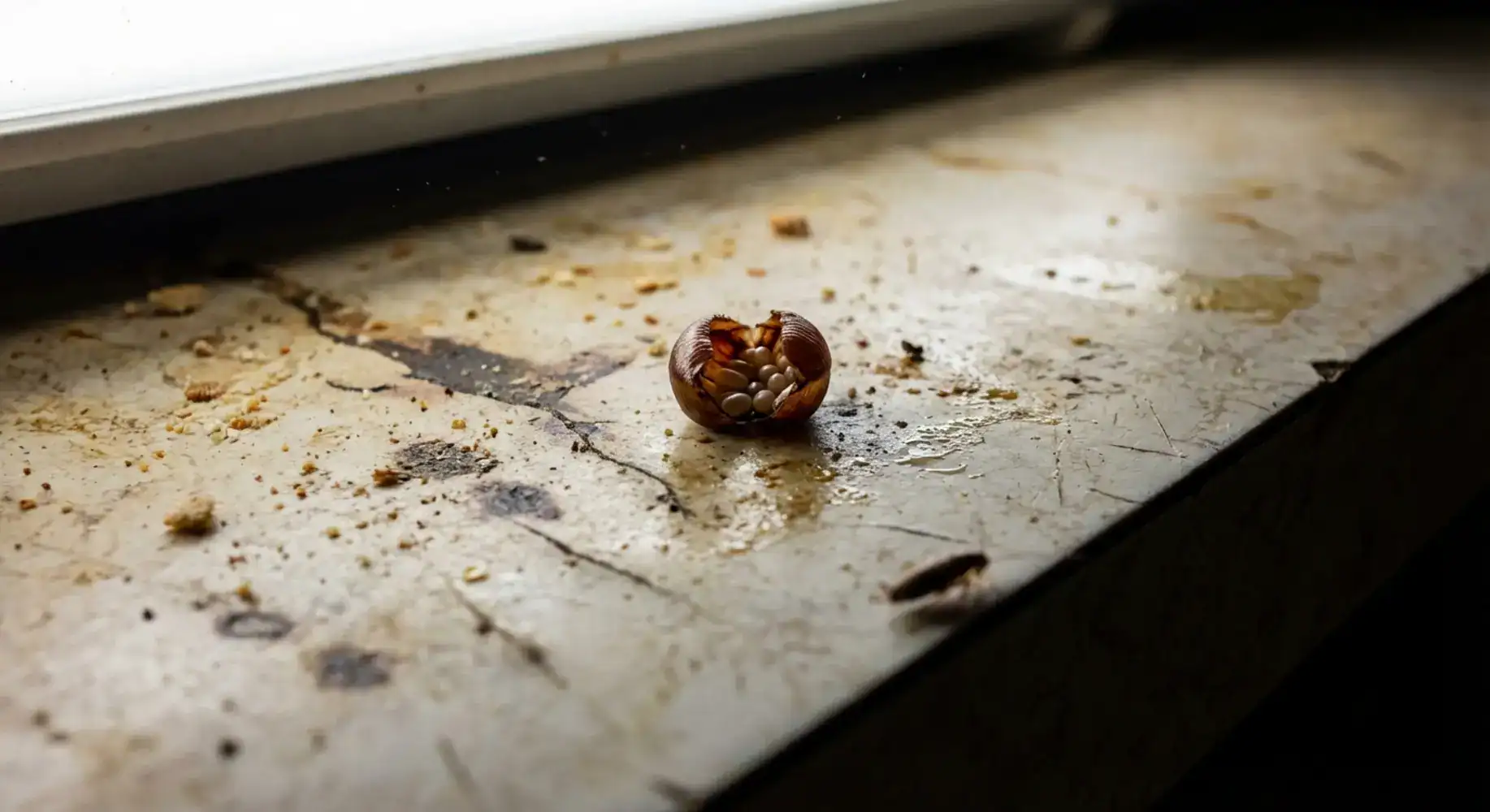
The starting point of every infestation is the ootheca (plural: oothecae). This is not just a single egg but a hardened, purse-like capsule that is remarkably resilient.
- Appearance: The ootheca is light brown, about 1/4-inch long, and looks like a tiny, ridged briefcase.
- Egg Count: Each case contains an average of 30 to 48 eggs.
- Gestation Period: A female carries the ootheca protruding from her abdomen for about 28 days. She strategically deposits it in a hidden, secure location-like a dark crevice or behind an appliance-just 1-2 days before the eggs are ready to hatch.
- Chemical Resistance: The tough, waxy coating of the ootheca makes it nearly impervious to most over-the-counter insecticide sprays. This is a critical point of failure for DIY pest control.
A single female can produce 4 to 8 oothecae in her lifetime, resulting in over 300 offspring from just one roach.
| Stage of Development | Average Duration | Key Characteristics |
|---|---|---|
| Egg (Ootheca) | 14-35 days (avg. 28) | Resistant to sprays; contains 30-48 embryos; hidden in cracks. |
| Nymph | 40-60 days | Wingless; molts 5-7 times; dark brown with a pale stripe. |
| Adult | 140-280 days | Winged (but rarely flies); reproduces constantly; tan with two dark stripes. |
Stage 2: The Nymph – The Hidden Army
Once the ootheca hatches, dozens of nymphs emerge. These are essentially miniature, non-reproductive versions of adult cockroaches. This stage is all about growth, and it’s where the population numbers truly begin to swell.
- Appearance: Nymphs are tiny (as small as a pinhead), dark brown or black, and wingless. They are most easily identified by a single light-tan stripe running down the center of their back.
- Molting Process: To grow, nymphs must shed their exoskeleton in a process called molting. They typically go through 5 to 7 molting phases (instars) before reaching adulthood. After each molt, the nymph appears white and is extremely vulnerable until its new shell hardens.
- Behavior: Nymphs are even more secretive than adults. They wedge themselves deep into the tiniest cracks and crevices, often far from where you might spray. A thriving infestation is composed of up to 75% nymphs, meaning the vast majority of the population is hidden from view and direct spray contact.
- Diet: Young nymphs have a high demand for protein to fuel their growth, often consuming the feces of adult roaches. As they mature, their diet shifts to include more carbohydrates, which are necessary for energy and eventual reproduction.
Stage 3: The Adult – The Breeding Machine
After its final molt, the nymph emerges as a fully grown, sexually mature adult. The German cockroach lifespan at this stage is dedicated almost entirely to feeding and reproduction.
- Appearance: Adults are about 1/2 to 5/8-inch long, tan to light brown, and have fully developed wings. Their most distinct feature is the two dark, parallel stripes on their pronotum (the shield-like plate behind the head). While they have wings, they rarely fly and prefer to run.
- Reproductive Speed: A female can become fertile and ready to mate within just 4 to 6 days of reaching adulthood. Because of this rapid turnaround, the German cockroach reproduction cycle is brutally efficient.
- Lifespan: An adult German cockroach can live for 140 to 280 days, with females generally living longer than males. Throughout this time, she will continue to produce egg cases, perpetuating the cycle.
The Myth of the Instant Cure: Why One Spray Fails
You’ve sprayed the roaches you saw, but two weeks later, your kitchen is teeming with tiny dark specks that scurry into the shadows. This isn’t a new invasion; it’s the predictable outcome of a flawed strategy. The failure of common pest control sprays is rooted in cockroach biology.
The Impenetrable Ootheca: Your Spray’s Greatest Weakness
The primary reason one-off sprays fail is the ootheca. As mentioned, this egg case is a biological fortress. Common active ingredients in household sprays, such as pyrethroids, are contact killers. They must physically touch the cockroach to be effective. The ootheca’s casing prevents the chemical from reaching the developing embryos inside.
So, while your spray might kill every adult and nymph it touches, you’ve left behind dozens of “time bombs.” In about 28 days, these will hatch, releasing a new generation of pests into a space you thought was clear. This highlights the critical importance of addressing egg cases in cockroach control.
The 75% Hidden Population Rule
Remember that in an established population, only about 25% of the cockroaches are adults. The other 75% are nymphs. These smaller, more vulnerable-looking roaches hide in places your spray will never reach:
- Inside wall voids
- Behind baseboards and trim
- Within the motor housings of appliances (refrigerators, microwaves)
- Underneath peeling wallpaper or paint
A surface spray only addresses the tip of the iceberg-the few foraging adults you happen to see. The hidden factory of nymphs continues its work uninterrupted, ensuring the infestation rebounds quickly.
Growing Insecticide Resistance
Beyond the life cycle, there is another biological factor at play: resistance. German cockroaches reproduce so quickly that they can develop resistance to chemical pesticides at an alarming rate. If a few roaches with a slight genetic resistance survive a spraying, they pass that trait on to their hundreds of offspring. Over time, this leads to entire populations that are unfazed by chemicals that were once effective. Constant, repetitive spraying with the same product can actually worsen the problem by creating a stronger, more resilient cockroach population in your home.
Beyond the Spray: A Smarter Approach with Integrated Pest Management (IPM)
If sprays are a losing battle, what is the long-term solution for preventing German cockroach re-infestation? The answer is a comprehensive strategy called Integrated Pest Management (IPM). IPM is not a single product but a holistic, knowledge-based approach that uses multiple tactics to attack the infestation from every angle.
IPM focuses on understanding cockroach biology and behavior to create an environment where they cannot survive. It is the gold standard for professional pest control and the most effective way for you to achieve lasting results.
Step 1: Sanitation – Remove Their Resources
Cockroaches need three things to thrive: food, water, and shelter. An IPM plan starts by systematically removing them.
- Food: Store all food in airtight containers. Clean up crumbs and spills immediately. Wash dishes nightly and never leave pet food out overnight. Regularly clean grease from stovetops and exhaust fans.
- Water: Fix leaky pipes and faucets. Dry out sinks and bathtubs before bed. Place a towel against the shower door to block access.
- Clutter: Remove stacks of cardboard, paper bags, and old newspapers. Clutter provides ideal, dark harborage for cockroaches to hide and breed.
Step 2: Identification and Exclusion – Find and Seal Their Homes
You must become a detective. Using a flashlight, inspect common hiding spots to find their “harborage areas.” Signs of German cockroach infestation in homes include:
- Droppings: Look for small, dark specks that resemble black pepper or coffee grounds.
- Shed Skins: As nymphs molt, they leave behind their papery, light-brown exoskeletons.
- Musty Odor: A large infestation produces a distinct, oily, and musty smell.
Once you find their hiding spots, seal them off. Use caulk to fill cracks in walls, gaps around pipes, and crevices between countertops and walls. Denying them shelter is a key pest control strategy.
Step 3: Strategic Application – Baits and Growth Regulators
This is where you fight back intelligently. Instead of indiscriminate sprays, IPM uses targeted products that exploit the German cockroach life cycle.
- Gel Baits: Products like Advion Cockroach Gel Bait are highly effective. You apply small dabs of the bait in the harborage areas you identified. Roaches consume the slow-acting poison and carry it back to their hiding spots. When they die, other roaches cannibalize them, spreading the poison throughout the hidden population. This method effectively targets the 75% of nymphs you can’t see.
- Insect Growth Regulators (IGRs): IGRs are the secret weapon against the reproduction cycle. They don’t kill roaches directly. Instead, they are hormones that disrupt the molting process and prevent nymphs from developing into reproductive adults. An IGR like Gentrol can be used as a spray or in point-source devices. It effectively sterilizes the population, breaking the life cycle and causing the infestation to collapse over time.
Step 4: Monitoring – Track Your Progress
Place sticky traps (glue boards) in areas of high activity. These traps will not solve the infestation on their own, but they are an invaluable monitoring tool. They help you confirm where the roaches are hiding, assess the severity of the infestation, and track the success of your IPM program over time.
Professional Pest Control vs. DIY: When to Make the Call
A dedicated DIY approach using IPM principles can be effective for a minor infestation. However, the difficulty in eliminating German cockroaches often requires professional intervention.
A DIY attempt with a $15 can of spray is a sunk cost when the infestation rebounds. A professional service might cost $200-$500 for an initial treatment, followed by a monthly or quarterly maintenance plan around $50-$150. While the upfront cost is higher, you are paying for expertise and access to commercial-grade products that are more effective and strategically applied.
Professionals are trained to identify all potential harborage sites and use a combination of baits, IGRs, and targeted insecticide dusts in a way that is safe and maximally effective. If you see cockroaches during the day, it is a sign of a very heavy infestation, and you should call a professional immediately. Are you ready to invest in your home’s health and peace of mind?
The Unseen Danger: Health Risks of a Cockroach Infestation
German cockroaches are more than just a nuisance; they pose significant health risks. Their presence can degrade the air quality in your home and lead to serious medical issues.
The primary concern revolves around allergens. Cockroach saliva, feces, and shed body parts contain proteins that are powerful allergens for many people. These microscopic particles become airborne and can trigger:
- Asthma Attacks: Cockroach allergens are a leading trigger for asthma, particularly in children living in urban environments.
- Allergies: Symptoms can include skin rashes, sneezing, itchy eyes, and a stuffy nose.
Furthermore, cockroaches are mechanical vectors for disease. They crawl through sewers, garbage, and other unsanitary areas, picking up pathogens on their legs and bodies. They can then transfer these germs to your food and food preparation surfaces. Diseases they are known to carry include Salmonella, E. coli, and various forms of gastroenteritis. Understanding the health risks associated with German cockroaches and their droppings should be a powerful motivator for implementing a thorough control plan.
Common Questions About German Cockroach Life Cycle: Why One Spray Fails
What are the common signs of a cockroach infestation?
The most common signs are droppings that look like black pepper, shed skins from molting nymphs, and a distinct musty or oily odor in heavily infested areas. You may also find live cockroaches, typically in warm and humid places like kitchens and bathrooms, especially when you turn on a light at night.
How long does it take for a German cockroach to mature?
Under optimal conditions (warmth and humidity), a German cockroach can mature from egg to a reproductive adult in as little as 50 to 60 days. This incredibly fast maturation is why a small problem can escalate into a major infestation so quickly, making prompt action crucial.
Why do German cockroaches prefer warm, humid environments?
German cockroaches have tropical origins, so their biology is adapted to thrive in conditions that provide both warmth and moisture. This is why they are most commonly found in kitchens and bathrooms, near appliances that generate heat (refrigerators, dishwashers) and sources of water (sinks, pipes). Control strategies should focus on reducing humidity in these areas.
Are there any natural methods to control cockroaches?
Yes, there are less toxic options, but they require proper application. Diatomaceous earth (food-grade) is a fine powder that dehydrates cockroaches when they walk through it, but it must be applied as a very thin layer in dry, undisturbed areas. Boric acid is another powder that acts as a stomach poison when ingested during grooming. Both are less effective in humid conditions and are slower to act than chemical baits.
What is the best spray for German cockroaches?
There is no single “best” spray because sprays are fundamentally a limited tool against the German cockroach life cycle. A non-repellent residual spray combined with an Insect Growth Regulator (IGR) is far superior to a standard repellent contact killer. However, the most effective pest control strategies prioritize baits and dusts over liquid sprays for long-term control.
How many eggs do German cockroaches produce?
A single female German cockroach produces between 4 and 8 egg cases (oothecae) in her lifetime. Since each ootheca contains 30 to 48 eggs, one female can be responsible for producing between 120 and 384 offspring directly, which then go on to reproduce themselves.
Why are German cockroaches so hard to eliminate?
Their difficulty stems from a combination of factors: a very fast reproductive cycle, the protective nature of their egg cases against sprays, their ability to hide in tiny, inaccessible cracks, and their rapid development of resistance to chemical pesticides. Eliminating them requires a persistent, multi-faceted approach that breaks their life cycle.
References & Expert Sources
- EPA Cockroach Management Tips
- UNL Horticulture Cockroaches Guide
- UMN Extension Cockroach Identification
- University of Michigan Museum of Zoology – Animal Diversity Web: Blattella germanica
- North Carolina State University Extension, Entomology – German Cockroach
- MGK – Cockroach Protocol: Biology of German Cockroaches
- Orkin – German Cockroach Life Cycle Phases
- Dr. Killigan’s German Cockroach Life Cycle
- Terminix – German Cockroach Facts & Information
- Ecolab – 2022 Pest of the Year: The German Cockroach
Final Thoughts
The fleeting satisfaction of a single spray is a trap that leads to endless frustration and a thriving cockroach population. The true path to a pest-free home lies in understanding the enemy. By recognizing the resilience of the ootheca and the hidden army of nymphs, you can see why a multi-pronged attack is not just better-it’s essential. Embracing an Integrated Pest Management strategy empowers you to disrupt every stage of the German cockroach life cycle. It requires more effort than simply spraying, but it is the only way to achieve a lasting victory, protect your family’s health, and reclaim your home for good.