Finding a strange bug on your mattress usually triggers pure panic. If you are waking up with itchy red marks or spotting tiny insects near your baseboards, determining whether it is a carpet beetle vs bed bug is your absolute first priority. Misidentifying these specific household pests leads to highly ineffective treatments, wasted money, and immense psychological stress. Before you throw away a valuable mattress or hire an expensive exterminator, take a deep breath. There is a massive statistical chance you are looking at a completely different insect.
Physical Appearance: Spotting the Structural Differences
Identifying the exact physical traits of these two insects is the foundational step in proper pest control. Knowing their specific size, shape, and developmental stages prevents costly misidentification.
According to a late 2025 survey from the National Pest Management Association, 90% of pest control professionals are called to treat suspected bed bugs that turn out to be completely different insects . Specifically, carpet beetles account for 60% of all false bed bug alarms. To avoid becoming part of this statistic, you must understand insect identification visually.
Cimex lectularius is defined as the common bed bug, a parasitic insect that feeds exclusively on human blood. Anthrenus verbasci is defined as the varied carpet beetle, a common scavenging insect that feeds on natural fibers and keratin. If you want to master carpet beetle identification, you must look closely at their outer shells. Adult carpet beetles are convex, meaning they have a domed back resembling a tiny, dark ladybug. They measure between 1.5 and 4 millimeters. Their shells feature mottled patterns of black, white, brown, and yellow scales.
In contrast, bed bug identification requires looking for a distinct paper-flat profile. Unfed adult bed bugs measure 4 to 7 millimeters long. They are a uniform reddish-brown color. Think of it like this: a bed bug looks exactly like an apple seed with legs.
Here is exactly how their adult forms compare side-by-side:
| Feature | Bed Bugs | Carpet Beetles |
|---|---|---|
| Size | 4 to 7 mm long | 1.5 to 4 mm long |
| Shape | Flat, oval (like an apple seed) | Convex, domed (like a tiny ladybug) |
| Color | Uniform reddish-brown | Mottled spots of brown, white, yellow |
| Wings | Wingless (cannot fly) | Have functioning wings (can fly) |
Bed Bug Nymphs vs Carpet Beetle Larvae
Understanding the lifecycle and behavior of carpet beetles and bed bugs is where many homeowners get confused. Bed bugs undergo incomplete metamorphosis. This means their young, known as nymphs, look like tiny, translucent versions of the adult insects. You will rarely mistake them for anything else once you know what to look for.
Conversely, carpet beetles undergo complete metamorphosis. The larvae of carpet beetles look radically different from the adult beetles. Often called “woolly bears,” these larvae resemble fuzzy, tiny caterpillars covered in dense bristles. They display horizontal stripes of brown and tan. If you find a tiny, hairy worm crawling in your closet, it is categorically not a bed bug.
Analyzing Signs of Infestation in Your Home
Early detection relies on finding the specific biological and environmental clues left behind, because actually seeing live bugs during the daytime is quite rare. Each pest leaves a distinct, recognizable signature in your home.
Difficulty in spotting early signs of infestations causes many property owners to delay treatment unnecessarily. When you inspect your living space, you must look for secondary evidence. Signs of bed bugs in home environments usually center heavily around the sleeping area. Because they are obligate hematophages – meaning they require a human blood meal to survive – they stay dangerously close to their food source.
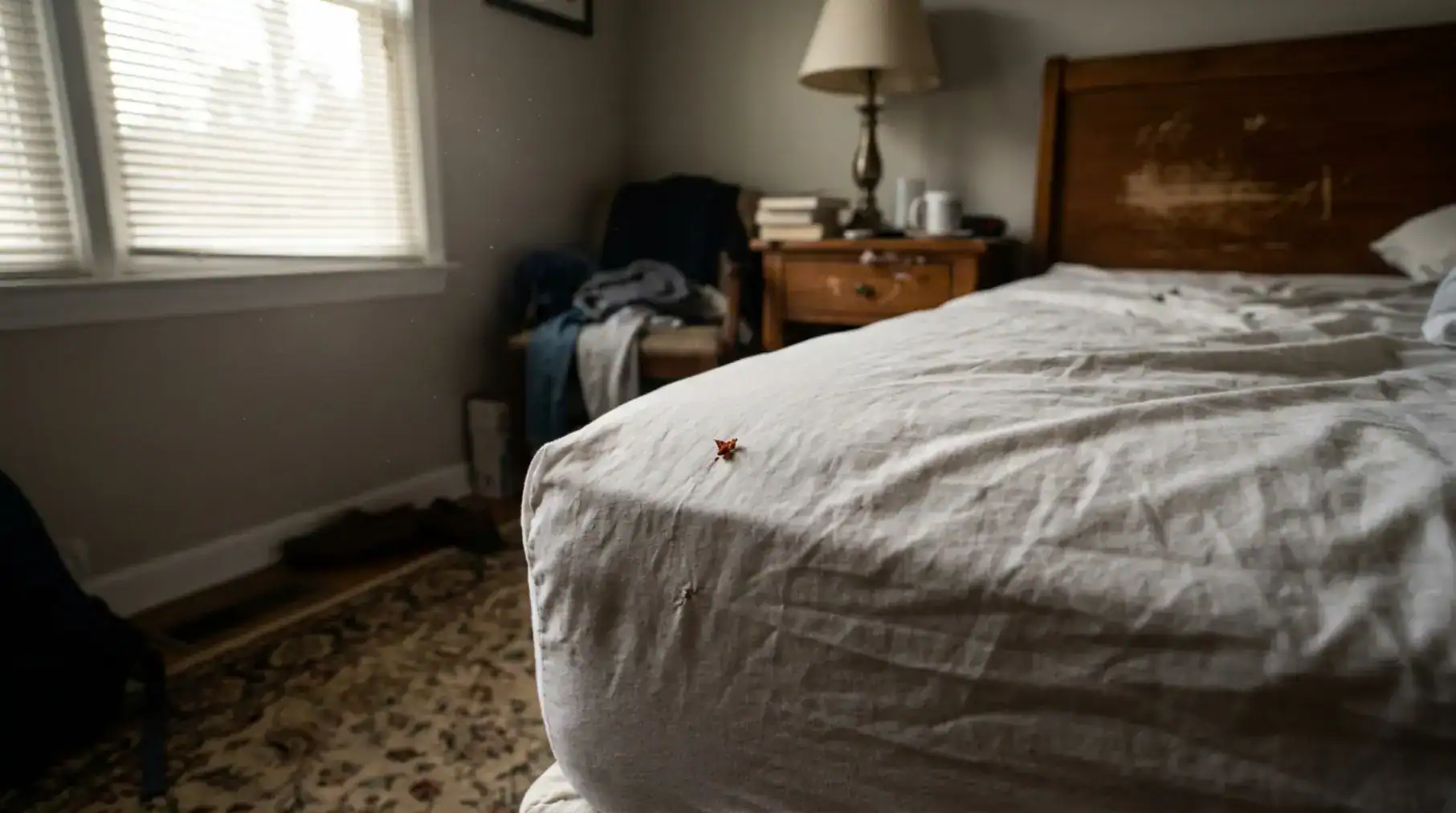
You must check the seams of mattresses, the wooden slats of box springs, and the screw holes in headboards. Look for tiny rust-colored stains on your bed sheets. These stains are actually crushed bugs or digested human blood. Additionally, you will often find dark, ink-like fecal spots heavily concentrated on the mattress fabric.
Signs of carpet beetles manifest quite differently. These scavenging insects feed on dead animal products, wool, silk, feathers, leather, and outdoor pollen. Consequently, signs of carpet beetles include irregular holes chewed cleanly through your natural fiber clothing or stored blankets. They do not leave blood spots.
When comparing carpet beetle infestations vs bed bug infestations, remember a simple rule. The former ruins your expensive wardrobe, while the latter targets your physical body. Proper identification requires you to play detective with the damage left behind.
Bites vs Rashes: Unraveling the Health Impacts
Bed bugs actively bite humans for blood, while carpet beetles do not bite at all, though their fuzzy larvae cause allergic skin reactions that closely mimic bite marks. Misunderstanding this critical distinction leads to severe medical misdiagnosis.
Health concerns related to bites from pests drive the most urgent exterminator calls. Let’s clear up the biggest myth in pest control right now. Do carpet beetles bite humans? No. Adult carpet beetles and their larvae literally lack the biological mouthparts required to pierce human skin. They are physically incapable of biting you.
So why are you waking up feeling incredibly itchy? The larvae of carpet beetles are covered in microscopic, bristle-like hairs. When these brittle hairs rub against human skin or become airborne and land on your bed sheets, they trigger an aggressive immune response. This creates allergic reactions and skin irritation caused by histamine release .
This specific condition is known medically as carpet beetle dermatitis. It looks nearly identical to insect bites. You will see dry, red, itchy welts that resemble a spreading rash. Because people do not understand this mechanism, they naturally assume they have a biting pest.
Safety Note: If you experience severe respiratory issues or persistent secondary skin infections from scratching these rashes, you must consult a licensed dermatologist immediately.
In contrast, analyzing bed bug bites vs carpet beetle bites reveals completely different patterns. Bed bugs actually bite. They frequently feed in a linear pattern or clusters of three, colloquially known in the industry as “breakfast, lunch, and dinner.” The resulting itchy red welts can take several days to appear on your skin, depending on your individual histamine response. While bed bugs are not known to transmit systemic diseases, the psychological toll of being a food source causes extreme sleep deprivation.
Behavioral Patterns and Habitat Preferences
Knowing where these insects hide and how they behave dictates exactly where you should focus your physical inspection efforts. Bed bugs cling tightly to human resting areas, while carpet beetles prefer dark storage spaces and bright light sources.
Differences between carpet beetles and bed bugs extend heavily into their daily habits. Think of it like a biological game of hide-and-seek where the two pests have entirely different survival goals. Bed bugs have co-habitated with humans for roughly 245,000 years . They have mastered the art of staying out of sight.
Where do bed bugs hide? They are strictly nocturnal parasites. They despise light and will squeeze their flat bodies into spaces as thin as a standard credit card. They cluster tightly in mattress piping, behind hanging picture frames, and inside electrical outlets located near your bed. How to tell if you have bed bugs involves checking these highly specific micro-environments with a bright flashlight.
Where do carpet beetles hide? The adult beetles are phototactic, meaning they are biologically attracted to light. You will frequently find dead adult beetles resting on your windowsills. What attracts carpet beetles to your home initially is often pollen from outdoor plants or easy access to neglected natural fibers.
Do carpet beetles live on beds? They certainly can, but only incidentally. If your bedding contains genuine wool, or if heavy pet hair accumulates under the bed frame, larvae might forage there. However, unlike bed bugs, they are absolutely not there to feed on you. They are simply hunting for keratin-rich debris.
Professional Pest Control and Extermination Costs in 2026
Treating an active infestation requires radically different financial investments and chemical approaches depending on the specific insect involved. Professional bed bug treatments are significantly more expensive, highly toxic, and mechanically complex than carpet beetle interventions.
Cost-effective pest control solutions for homeowners always start with accurate identification. Misidentification of pests leading to ineffective treatments is a massive financial drain. If you pay for a bed bug heat treatment when you only have fabric pests, you waste thousands of dollars.
According to recent pricing data, a whole-home bed bug extermination averages exactly $2,500 . Heat treatments, which involve raising the ambient room temperature above 120 degrees Fahrenheit to kill all life stages simultaneously, can run anywhere from $400 to $5,500 depending on the property’s square footage.
Why is it so wildly expensive? Recent research confirmed that modern field strains of bed bugs are surviving heavy chemical exposures due to severe pyrethroid resistance . You cannot simply spray them away with cheap hardware store chemicals anymore. The bugs process the toxins and continue reproducing.
Pest control for carpet beetles and bed bugs differs wildly in execution. Typical exterminator rates for treating carpet beetles run between $150 and $300 per room. Knowing how to get rid of carpet beetles is largely a matter of applying basic integrated pest management (IPM) principles rather than aggressive chemical warfare.
Home Remedies Versus Professional Extermination Options
If you face a carpet beetle vs bed bug scenario, your intervention approach must match the biology of the pest.
For carpet beetles, heavy vacuuming of baseboards, steam cleaning carpets, and washing affected clothes in hot water will often resolve the entire issue without requiring toxic chemicals. Food-grade diatomaceous earth sprinkled in closet corners physically shreds the larvae’s exoskeletons, dehydrating them effectively.
For bed bugs, home remedies are notoriously dangerous and largely ineffective. Over-the-counter bug bombs are actually the worst tool you can use.
Safety Note: You must never use aerosol bug bombs for bed bugs. The airborne chemicals do not penetrate deep wall voids. Instead, they act as a chemical repellent, scattering the surviving insects into neighboring rooms and making the infestation exponentially harder to eradicate.
You must rely on professional extermination for blood-feeding parasites. Professionals use a combination of canine detection, specialized residual dusts, and targeted heat applications to ensure every single egg is neutralized.
Best Practices for Prevention of Infestations in Households
Proactive monitoring and strict quarantine protocols are the only proven ways to keep parasitic and fabric-destroying insects permanently out of your living space. Prevention is always exponentially cheaper than paying for structural extermination.
Whether you are dealing with carpet beetles, bed bugs, or other miscellaneous household pests, building a defensive perimeter is essential. You must adopt a preventative mindset. Are carpet beetles harmful to humans? While they do not spread dangerous blood-borne diseases, the severe damage they cause to heirloom fabrics and the irritating allergic reactions they provoke make rigorous prevention absolutely necessary.
Here are the precise steps to secure your home:
✓ Inspect all second-hand furniture and vintage clothing thoroughly before bringing it inside.
✓ Install high-quality, tear-resistant mattress encasements immediately.
✓ Place sturdy plastic interceptor traps under all four legs of your bed frame.
✓ Store all out-of-season wool, silk, and leather garments in airtight plastic containers.
✓ Vacuum closet floors, window tracks, and areas under large furniture weekly.
✓ Seal cracks in wooden baseboards with silicone caulk to eliminate travel routes.
When traveling, check your hotel mattress seams before unpacking your luggage. Upon returning home, wash all your travel clothes immediately in hot water. High heat destroys hitchhiking eggs before they can establish a colony in your bedroom.
Common Questions About Carpet Beetles vs. Bed Bugs: Spotting the Difference
What bug looks exactly like a bed bug but isn’t?
Bat bugs and swallow bugs look nearly identical to bed bugs to the naked human eye. However, in standard residential settings, panicked homeowners most frequently mistake adult varied carpet beetles for bed bugs due to their similar small size and oval shape. You need a magnifying glass to easily spot the carpet beetle’s mottled color patterns and functional wings.
How to tell carpet beetles from bed bugs quickly?
Look directly for wings and assess their behavior. If the insect flies away or crawls aggressively toward a bright window, it is a carpet beetle. If it is entirely flat, wingless, strictly hides in dark mattress crevices, and leaves rust-colored blood spots on your bed sheets, you are looking at a bed bug.
Do carpet beetles leave blood spots on sheets?
No. Carpet beetles do not consume human blood, so they physically cannot leave rust-colored blood stains or dark fecal matter on your bedding. If you find unexplained blood spots, you are dealing with a hematophagous pest, and you must start bed bug identification protocols immediately.
Will vacuuming get rid of carpet beetles?
Yes, intensive and highly consistent vacuuming is highly effective for carpet beetle control. It removes the shedding pet hair, dead skin, and lint that the growing larvae feed on, while also physically removing the fragile eggs from your carpets. However, vacuuming alone rarely cures an established bed bug issue.
Can dogs smell carpet beetles?
No, commercial pest detection dogs are specifically trained to identify the unique chemical pheromones emitted by live bed bugs and viable eggs. While canine detection remains the absolute gold standard for finding hidden bed bug colonies in complex environments, it is not utilized for tracking fabric-eating pests.
References and Expert Sources
Verifying the scientific and economic data surrounding household insect management ensures you are making critical home decisions based on hard facts, not fear. Below are the primary sources used to compile this guide.
- National Pest Management Association: Bugs Without Borders 2025 Survey
- Swiss Bed Bug Foundation: Pyrethroid Resistance Report
- Dermatology Research Institute: Studies on Allergic Contact Dermatitis from Insect Hairs
- EPA Registered Pesticide Guidelines for Residential Use
- National Average Extermination Pricing Data 2026
- University of Kentucky Entomology Department: Insect Identification Guides
- Entomological Society of America: Lifecycle of Anthrenus verbasci
- World Health Organization: Vectors and Pests Control Guidelines
- Journal of Economic Entomology: Efficacy of Heat Treatments
- American Academy of Dermatology: Identifying Insect Bites and Rashes
Final Thoughts
Discovering unwanted insects lurking in your home is always a deeply stressful event, but arming yourself with the correct entomological information changes everything. When faced with a carpet beetle vs bed bug scenario, remembering the key physical differences regarding wings, body shape, and feeding habits will immediately save you from blind panic. Knowing that you are merely dealing with a fabric-eating scavenger rather than a blood-feeding nocturnal parasite instantly lowers the emotional stakes of the situation.
Always document the physical evidence carefully before taking aggressive action. Capture the suspect insect in a small sealed plastic bag or take a clear macro photograph of the shed larval skins without crushing them. By thoroughly understanding how to properly execute accurate insect identification, you protect your wallet from unnecessary chemical applications and secure the respiratory and dermatological health of your family.
Do not let anxiety dictate your response to household pests. Take out your brightest flashlight, inspect those bedroom baseboards meticulously, and use the knowledge from this guide to confidently reclaim control of your home today.